
Which Ford Super Duty Should You Buy for a Flatbed Camper Build?
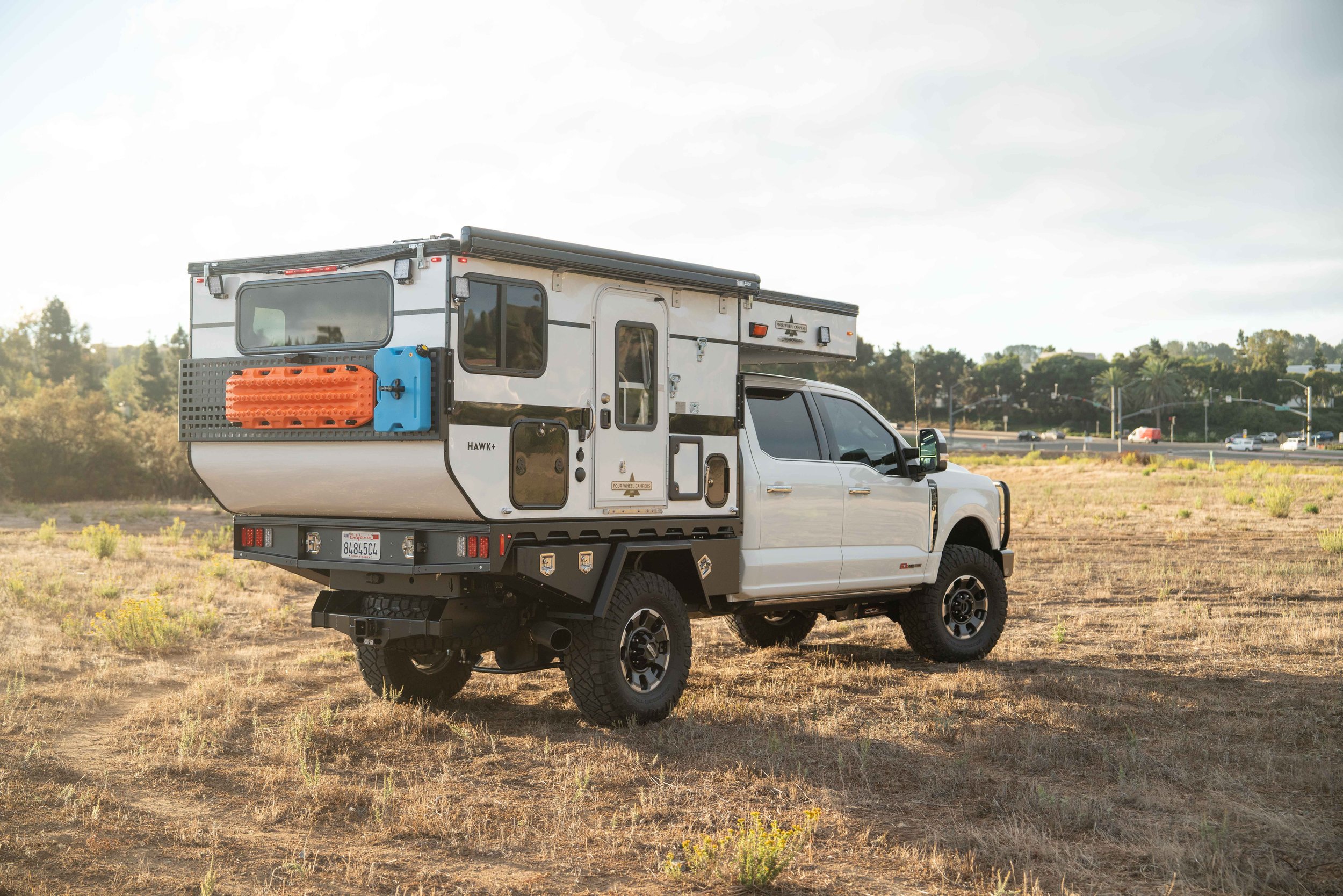
I have this conversation on the phone three or four times a week. Somebody calls the shop, they've been down the rabbit hole for a month, and they open with some version of the same question: F-250 or F-350? Gas or diesel? Tremor or FX4? And do I need the Platinum?
Most of the advice out there is written by people who have never taken a bed off a truck. It's payload charts and forum arguments about towing 30,000 pounds. Once you actually build one of these — flatbed, Four Wheel Camper, Carli suspension, full electrical system — a lot of that stops mattering, and a few small option-code details you've never heard of start mattering a lot.
So here's how we'd walk you through it, same as if you called the shop today.
One note before we start. Everything below is checked against Ford's 2026 order guide and spec sheet. Ford shuffles this stuff every model year, so treat the codes and prices as a starting point and confirm the build sheet on the actual truck you're looking at.
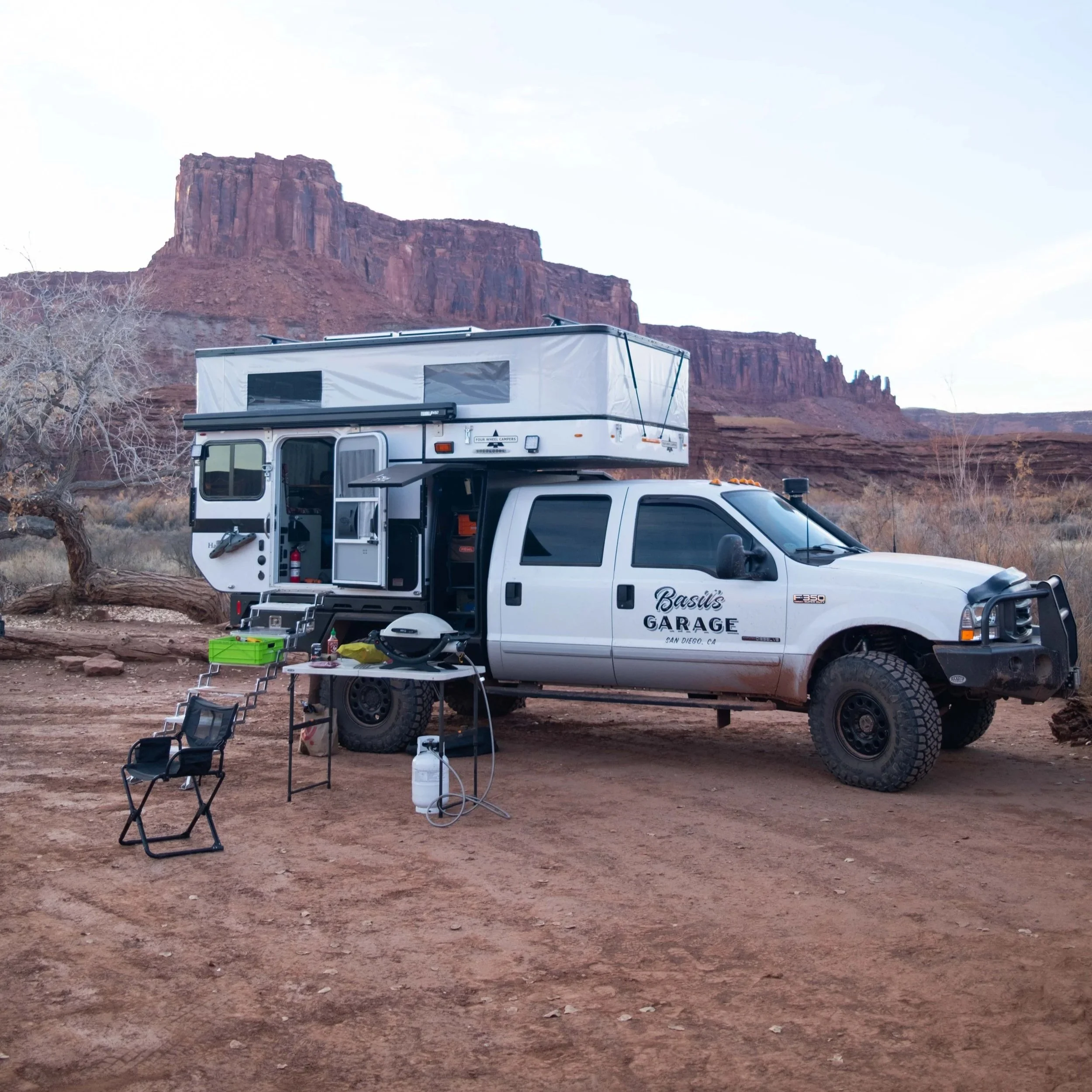
F-250 vs F-350: which one for a flatbed camper?
Short answer: buy whichever one you find the better deal on. Once we build it, they're the same truck.
The frame, cab, driveline, engine options, transmission, and bed are the same between them. On our end we don't even separate them — we call it the Super Duty chassis, because nearly everything we order is cross-compatible.
The real difference is the factory rear leaf spring pack, and on about 99% of the builds we do, that leaf pack comes out and gets replaced with a Carli system. Your factory spring rate and your overloads are gone before the truck ever leaves the shop.
The second difference is the rear axle, and this is where it gets murky. It isn't as clean as "F-250 gets this axle, F-350 gets that one." It depends on how the truck was optioned. Roughly, a base 10,000-pound-GVWR F-250 gets the Sterling 10.5-inch. Bump the GVWR above 10,000 and you're usually looking at the Sterling 11.6-inch. F-350 SRW trucks generally run the Dana M275, and duallies get the Dana M300. You can tell them apart in about four seconds by counting the bolts on the differential cover: twelve is the 10.5, fourteen is a Dana, sixteen is the 11.6.
Worth knowing on the F-250: the High Capacity Axle Upgrade package that gets you the 11.6-inch axle requires a diesel. You can't option it on a gas truck.
Here's the part nobody says out loud. For what we're doing — flatbed camper, suspension, 35s or 37s — you're not axle-limited. Our own 2021 F-250 runs the smaller Sterling 10.5 and has been pushed harder than most of our customers will ever push theirs. No issues. The bigger axle earns its keep when you're stacking weight on weight, like a full camper plus 10,000 pounds of trailer. If that's you, call us. If it isn't, and your whole decision is coming down to axle specs, you're solving the wrong problem.
On payload: yes, the F-350 usually wears a higher number on the door jamb sticker. But it's messier than the internet claims. Take a 2026 4x4 crew cab short bed with the 7.3 gas. On 17-inch wheels, the F-250 is rated at 4,034 pounds and the F-350 at 3,778 — the F-250 actually wins, because the F-350's base curb weight is higher. Move that same F-350 to the 18-inch all-terrain package and it jumps to 4,613. The payload advantage isn't really about the badge. It's about which wheel and tire package got checked.
If you're ordering new and they cost the same, take the F-350 and take the sticker. If you found a clean deal on a used F-250, take it and don't look back.
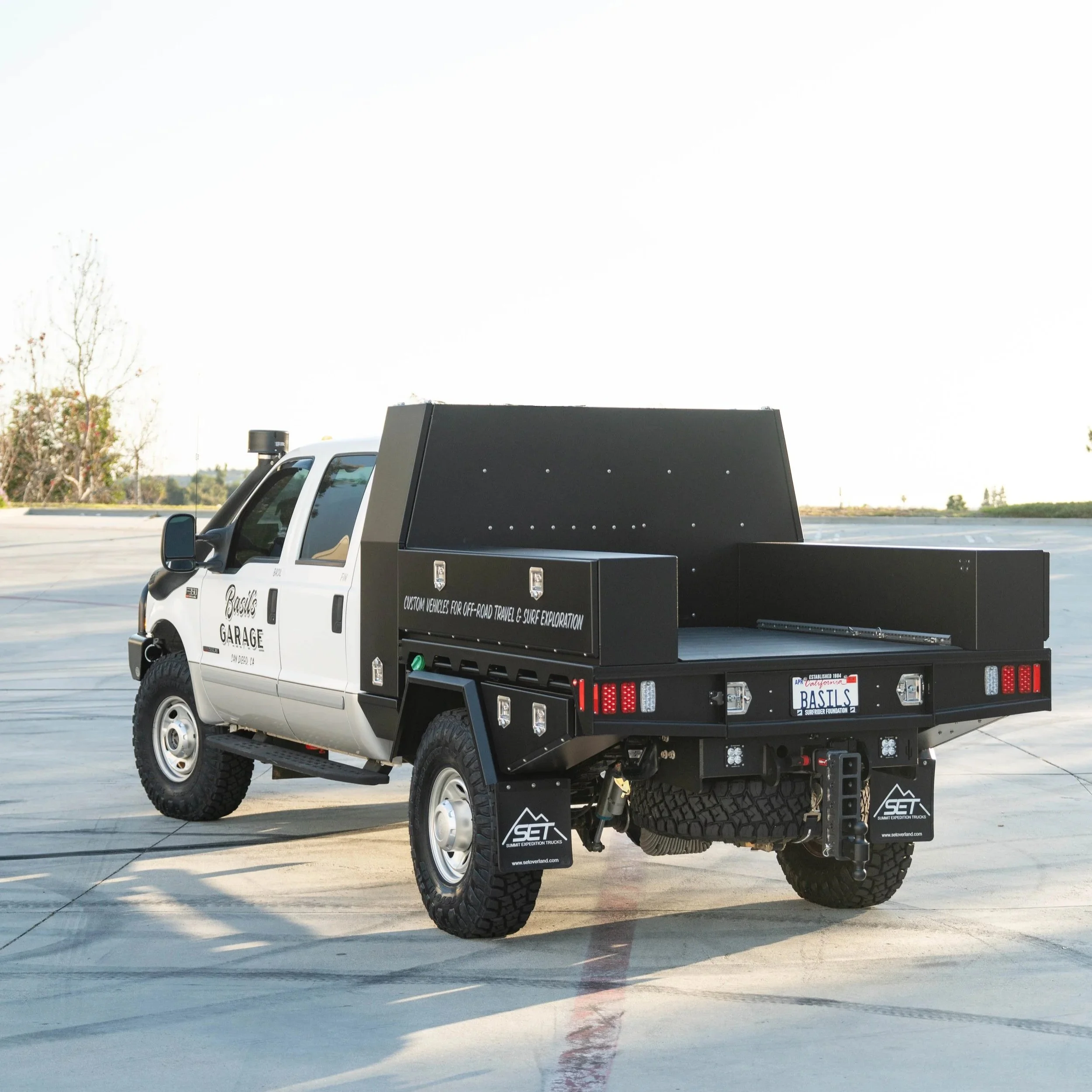
Gas vs diesel Super Duty: which for an overland camper build?
Short answer: diesel if you want drivability, elevation performance, and engine braking. The 7.3 gas if you want simple and cheap to own. We're running about 50/50 on these builds.
I personally lean diesel. The drivability is just insane. The 6.7 Power Stroke makes 475 hp and 1,050 lb-ft, and the high-output version is at 500 and 1,200. It's smooth, it's quiet, and it grunts everywhere without trying. You never wind it out, and it never feels like it's working — which matters more than you'd think once there's a camper on the back.
Diesel also does better at elevation because of the turbo. The gas engines are naturally aspirated, so they gasp for air up high the same way we do. The rule of thumb is about 3% power loss per 1,000 feet for a naturally aspirated engine, versus roughly 1% for a turbo. At 8,000 feet in Colorado that's the difference between losing about a quarter of your power and losing almost none of it. Climbing a pass with a loaded camper, you feel every bit of that.
Then there's the exhaust brake. Ford gives you manual push-button engine-exhaust braking on the Power Stroke. It works by closing the vanes inside the turbo, restricting exhaust flow, building compression, and holding the truck back. Think of it as cruise control, but downhill. Coming off a long grade with a camper, it feels dramatically more controlled, and you're not cooking your brakes the whole way down.
Fuel mileage leans diesel too, and here I want to give you numbers that actually apply to you. If you search around, you'll find stock 7.3 owners reporting 13 to 15 mpg. That is not what a built truck does. Our customers, with a flatbed, a camper, 35s or 37s, and everything loaded, see 9 to 11 mpg on the 7.3 gas and 12 to 14 on the diesel. That's roughly a 30% difference, and it compounds with tank size, which we'll get to.
Now the honest tradeoffs. Diesel is more complex. More maintenance, emissions systems, a 7.5-gallon DEF tank to keep filled, and more to go wrong. When something does go wrong, it costs more to fix. We rarely hear about issues, but they happen, and staying on top of maintenance is what keeps these trucks happy.
The 7.3 Godzilla is the opposite approach. 430 hp, 485 lb-ft, pushrod V8, no turbos, fewer failure points. It's a big dumb V8 in the best possible way. Cheaper to own, easier to maintain, and it'll just keep working if you take care of it.
One thing to watch for 2026: the 6.8L V8 is the standard gas engine on XL, XLT, and Lariat. The 7.3 is an option you have to specifically check. Don't assume a gas Lariat on the lot is a Godzilla — a lot of them aren't. And it matters, because the 6.8 makes 405 hp and 445 lb-ft, and it can't be optioned with the Lariat Premium package that carries adaptive cruise.
There's one more wrinkle for the 7.3 on an F-250. If you want the heavy-duty 10-speed behind it instead of the lighter-duty one, the order guide ties that to the Tremor package. On the F-350 SRW you can get the heavy-duty 10-speed with the 7.3 without going Tremor. It's a small thing, and both transmissions work fine, but it's the kind of detail that only shows up when you read the guide.
If it's my truck, I'm still picking diesel.
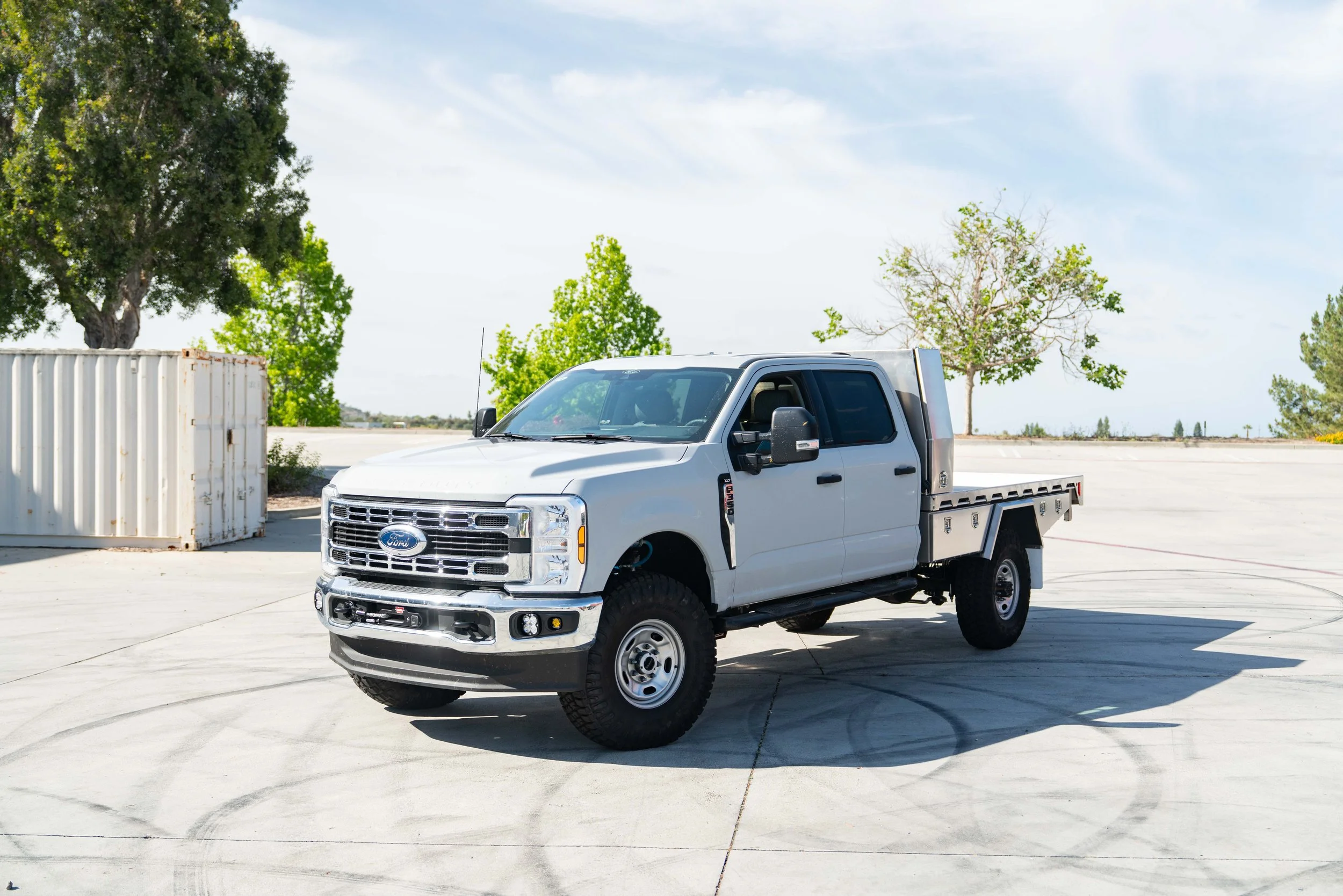
FX4 vs Tremor: which off-road package for a camper build?
Short answer: FX4, every time. It's $600 and it gets you the rear locker. Tremor is $4,450 and, more importantly, it can't be ordered with the 8-foot box or the Camper Package.
The FX4 Off-Road package is code 17X. It gets you Hill Descent Control, off-road-tuned shocks, skid plates for the transfer case and fuel tank, and a box decal. It also requires the all-terrain tires and the electronic-locking rear differential on single-rear-wheel trucks — which is the whole reason we recommend it. Six hundred bucks for a factory rear locker is the best money you'll spend at the dealer. Get the FX4.
Tremor, code 17Y, is a real package. Front limited-slip on top of the rear locker, 35-inch LT285/75R18 all-terrains, unique front springs with a ride-height increase, performance shocks, unique front air dams that take the approach angle from around 15 degrees to 30, water fording vent tubes, Rock Crawl mode, Trail Control, and Trail Turn Assist. It's genuinely capable.
But look at what you're actually keeping. The shocks come off for the Carli system. The springs come off. The tires come off for 35s or 37s that are properly load rated for what you're about to put on this truck. What survives is the front limited-slip, the drive modes, and the air dams — for about $4,450.
And here's the one that ends the conversation for most of our customers: Tremor is crew cab only, and it is not available with the 8-foot box. So if you want a long bed truck, Tremor is off the table entirely. It also can't be combined with the Camper Package or a dual rear wheel.
If you want to push the truck hard off-road and you're already committed to a short bed, Tremor is defensible. For most people carrying a camper, the rear locker is plenty.
One more thing worth knowing: Tremor forces the axle ratio. On the 7.3 gas it's 4.30, and on the diesel it's 3.55.
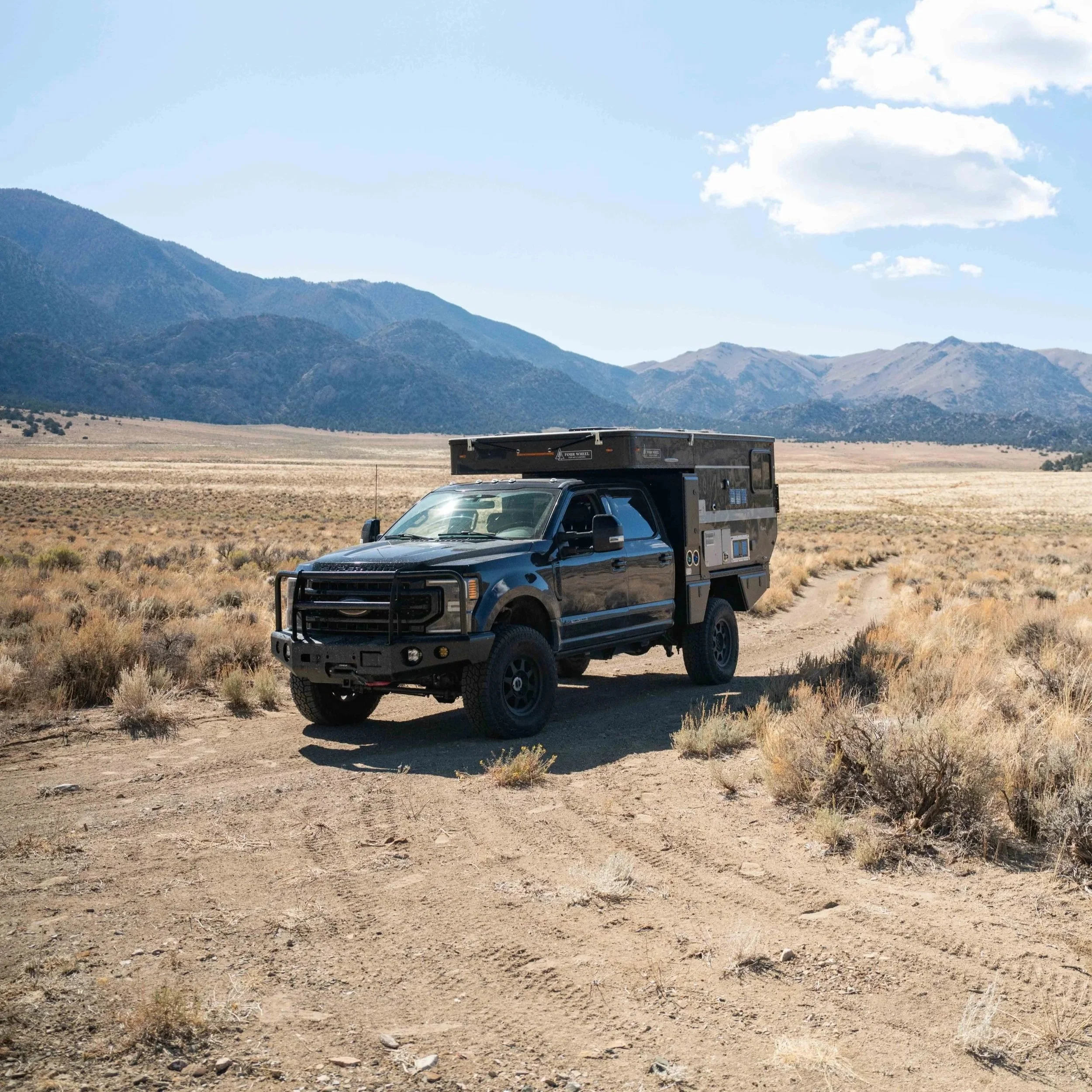
What about the Camper Package?
This one surprises people, so I'll be blunt: on a flatbed build, we usually tell customers to skip it.
Ford's Camper Package (code 471) gets you heavy-service front springs, rear auxiliary springs, a rear stabilizer bar, and slide-in camper certification. That's a reasonable package if you're dropping a traditional slide-in camper into a factory bed.
We're not doing that. We're removing the bed, bolting on a flatbed, and building the suspension from scratch. The rear aux springs and the spring rates are getting replaced. The slide-in certification doesn't describe your truck once it has a flatbed on it. You'd be paying for parts to come off and a certification that doesn't apply.
The Camper Package also blocks the Tremor package and can't be combined with 20-inch wheels, which is worth knowing if you're shopping a truck that already has it.
If you've already found a great deal on a truck with the Camper Package on it, that's totally fine — don't walk away over it. Just don't go add it to a factory order for a flatbed build.
Trim level: skip the Platinum, and probably the King Ranch too
For 2026 the ladder is XL, XLT, Lariat, King Ranch, and Platinum. About 90% of what we build is an FX4 Lariat, and that's what I'd personally buy for this.
Lariat gets you heated and ventilated front seats, the 12-inch center screen, LED lighting, the 360-degree camera, and the stuff you actually want on a twelve-hour driving day. If you want adaptive cruise with lane centering, that's the Lariat Premium package — it isn't standard on a Lariat, and it can't be ordered with the 6.8 gas engine.
The reason we steer people off the Platinum isn't the price. It's the back half of the truck. Platinum and King Ranch both come standard with a power tailgate, a tailgate step, and On-Board Scales with Smart Hitch. All of that lives in the bed and tailgate. All of it goes in the scrap pile when the flatbed goes on, and the sensors and wiring behind it become real labor to relocate. We can do it. We've done it. It just costs you money for zero gain.
Same logic on the Lariat Ultimate package — it bundles in a tailgate step and power running boards. Nice truck features. Not flatbed features.
Anything Lariat and down, you're good. We've got the sensor relocation dialed and it's straightforward.
The option codes that actually matter
This is the section I wish somebody had written for me. Four boxes to check, one to leave alone.
Get the dual alternator (code 67B). It's the single best thing you can do at order time to make the camper's electrical system better. More available power for the DC-to-DC chargers means more charging while you drive. It's standard on King Ranch and Platinum and optional everywhere else.
Skip Pro Power Onboard (code 43K). This is the one people get wrong. The 2kW bed outlet is useless once a camper is sitting where the bed used to be. Worse, it doesn't add a second 12-volt alternator — it swaps that second alternator to a 24-volt 150-amp unit that only feeds Pro Power. So instead of 410 amps at 12 volts, you're down to 250. You'd be paying to take away the thing you actually want. It also eats rear under-seat storage in some configurations, which is exactly where we'd want to put a freezer or a safe.
On axle ratio: the gas trucks run 3.73 or 4.30, and the diesels run 3.31 or 3.55. Take the numerically highest one available with the electronic locker. But with the 10-speed there's so much spread between the gears that it genuinely doesn't matter much. Don't walk away from a great used truck over gearing.
And don't spend money on the bed. Cargo lights, tailgate step, bed scales, spray-in liner, tonneau covers, the 5th wheel prep package. It all comes off. Put that money into the build.
One thing worth knowing if you're a planner: Ford does offer a Pickup Box Delete, so in theory you could order a truck with no bed at all. In practice it's a dead end for us. It's limited to XL and XLT long-wheelbase F-250s, and it can't be combined with the 7.3 gas engine, the FX4 package, Tremor, or the 360-degree camera. So you'd be giving up the engine and the locker to save a bed you were going to sell anyway. We just take the bed off.
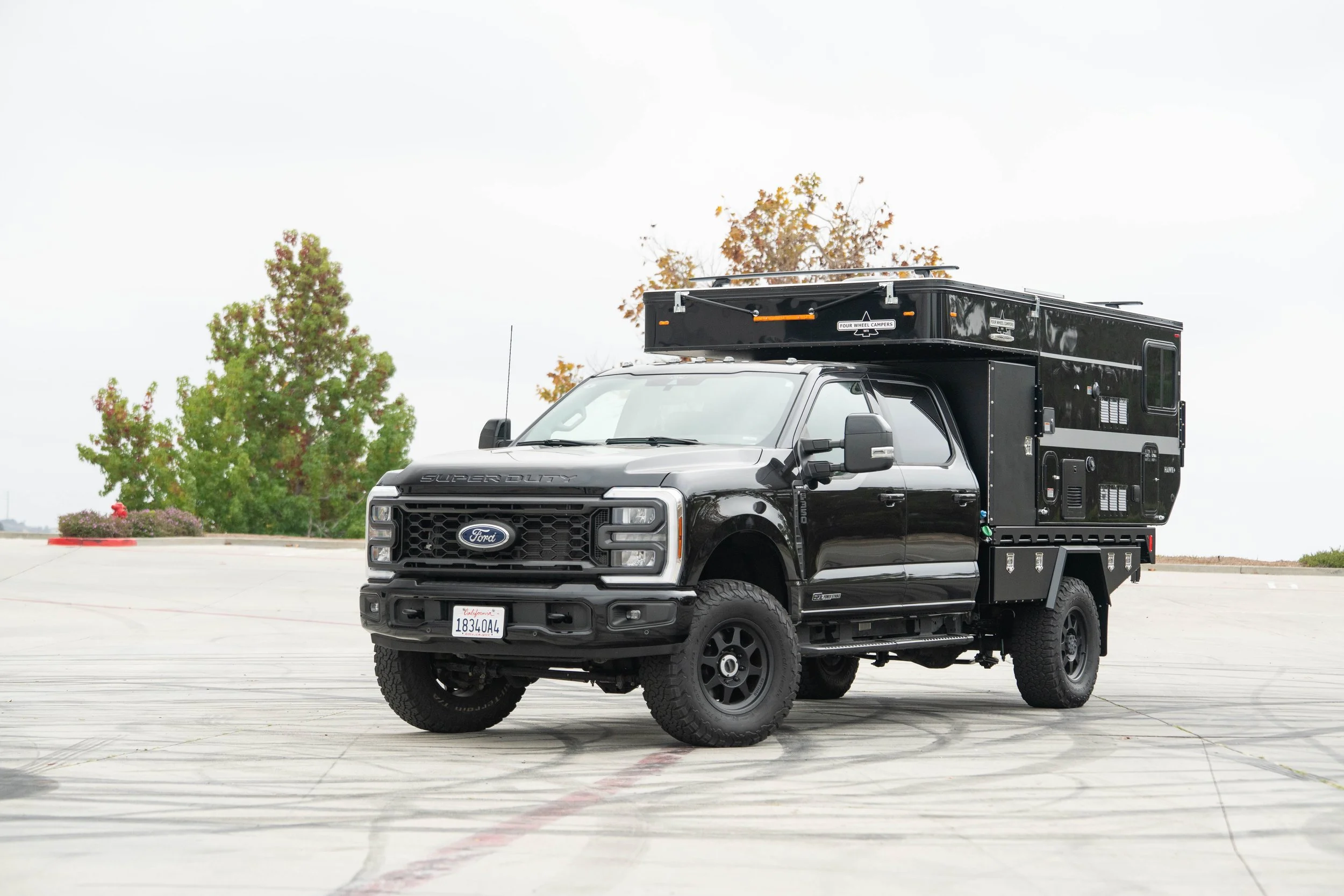
What I'd buy
Crew cab. Whichever of the F-250 or F-350 I found the better deal on. Diesel. FX4. Lariat. 410-amp dual alternator, upfitter switches, no Pro Power, no Camper Package, bone stock.
Then every remaining dollar into suspension, tires, and weight management. That's what you feel every single day you own the truck. Nobody has ever finished a trip and said the badge on the fender made the difference.
Build the truck on paper and you'll optimize for numbers. Build it for how you actually use it and you'll end up with something you love driving.
I'm working on a follow-up about how much weight these trucks actually gain once they're fully built, because that number surprises people.
In the meantime, if you're trying to figure out where to start, or you've got a truck listing you want a second opinion on, send it over. Give us a call, shoot us a message, or roll on by the shop. We do this every day, and we'd rather help you get it right the first time than fix it later.
Common questions
-
Neither, really. They share the frame, cab, engines, and transmission, and the rear leaf pack that separates them gets replaced during the build. Buy on price and condition. If you're ordering new and they cost the same, take the F-350 for the higher payload sticker.
-
No, and it actively works against a long bed build — Tremor can't be ordered with the 8-foot box, and it can't be combined with the Camper Package. The FX4 package is $600 and gets you the rear locker, which is the piece that matters. Tremor's remaining value on a camper build is the front limited-slip and the drive modes, for about $4,450.
-
A crew cab short bed holds 34 gallons and a long bed holds 48. With a flatbed, camper, and 35s or 37s, we see 9 to 11 mpg on the 7.3 gas and 12 to 14 on the diesel. That works out to roughly 305 to 375 miles on a short bed gas truck, and 575 to 670 on a long bed diesel.
-
No. It replaces the second 12-volt alternator with a 24-volt unit that only feeds the Pro Power outlets, dropping your 12-volt output from 410 amps to 250. Order the 410-amp dual alternator instead and put the power where the camper can use it.
-
Not for 2026. The 6.8L V8 is the standard gas engine on XL, XLT, and Lariat, and the 7.3 is a separate option. Check the window sticker rather than assuming.